A Custom LS2 Advant X Carbon Police Helmet
Built Around the Officer’s Assignment.
At highway speed, a motor officer’s helmet is protective equipment. At the roadside, at an intersection, during an escort, or at a public event, it is also part of the uniform.
The same helmet has to work in motion, through changing weather and light, during radio communications, and through repeated transitions between riding and face-to-face contact. It also needs to identify the officer clearly before a conversation begins.
This custom LS2 Advant X Carbon Police Helmet was built around that operating reality.
We used deep blue carbon across the upper shell, exposed black carbon through the lower shell and modular chin bar, a narrow yellow accent line, and yellow-and-blue POLICE identification across the front and sides.
The goal was not to make the loudest helmet in the parking lot. It was to create a helmet that looks correct on a police motorcycle, communicates agency identity, and preserves the technical character of the carbon-fiber platform.
This is not a retail graphic with POLICE lettering added at the end. The paint, carbon exposure, stripe placement, and identification were developed as one complete police configuration.
Configuration Shown
Helmet Platform LS2 Advant X Carbon
Upper Finish Custom Blue Carbon
Lower Finish Exposed Black Carbon
Accent Yellow Dividing Stripe
Identification Yellow-and-Blue POLICE Lettering
Final Finish High-Gloss Clear
01 — Paint Architecture
The Color Break Follows the Helmet.
The Advant X Carbon is not a simple, round helmet shell. It has pronounced upper vents, layered side panels, a large hinge assembly, shield hardware, and a rotating chin bar. A paint scheme that ignores those components can become crowded quickly.
We approached the design from the opposite direction. The molded architecture of the helmet determined where the colors would begin and end.
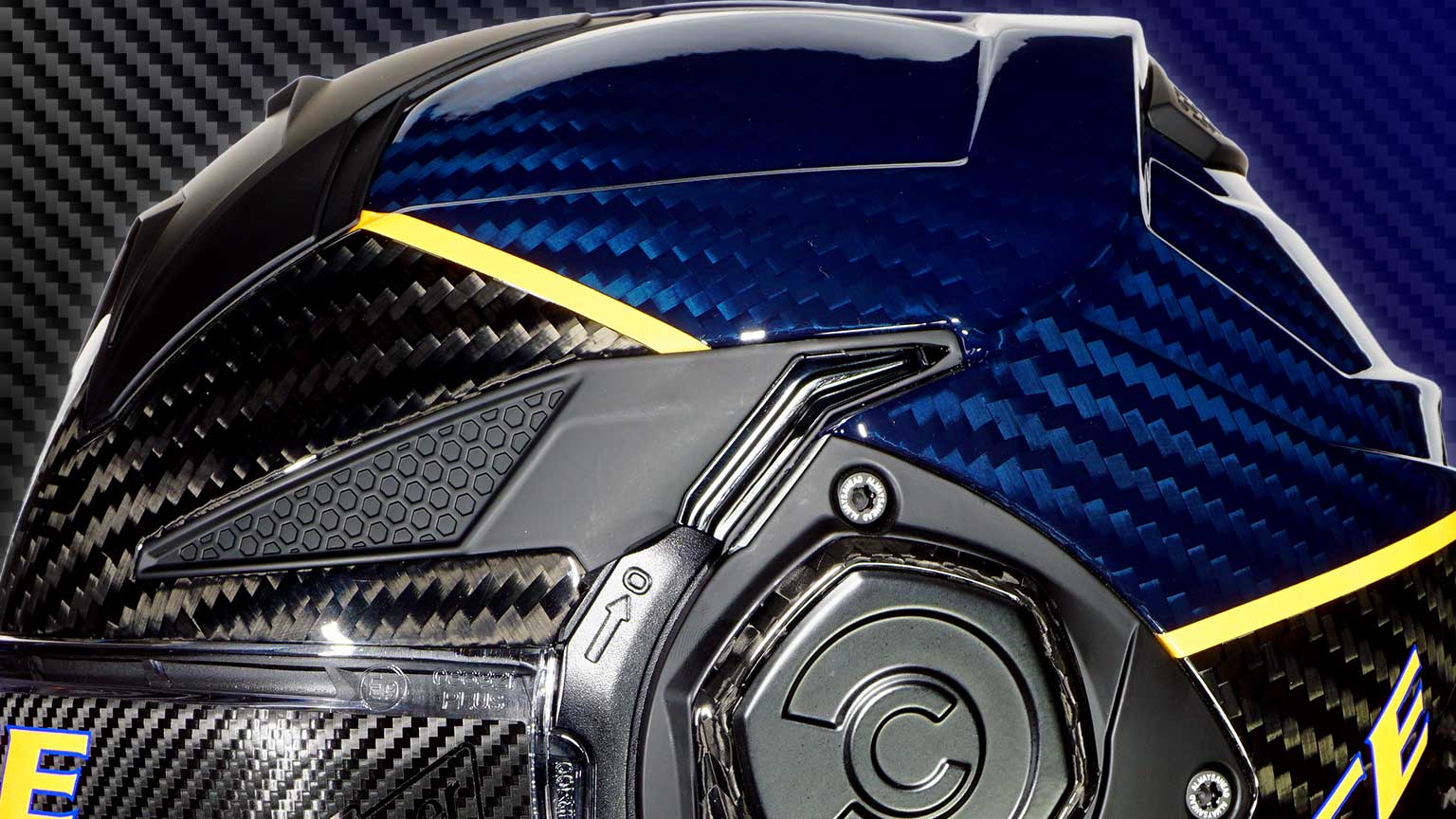 Built around the shell. The blue-to-black transition follows the helmet’s molded architecture rather than placing a generic stripe over the surface.
The blue carbon occupies the upper shell, where it has the greatest visual impact. Across the crown and upper side panels, the carbon weave changes with the direction of the shell. Under direct light, the blue becomes bright and electric. In shadow, it moves toward a deep navy.
Because the weave remains visible, the upper shell still reads as carbon fiber. It does not look like carbon that has simply been buried beneath a solid blue paint color.
The black carbon controls the lower half of the design. It connects the chin bar, side structure, lower shell, vents, shield mechanism, and black hardware into one visual foundation. The helmet contains a significant amount of mechanical detail, but the black carbon prevents those components from competing with the blue crown or the police identification.
Between the two finishes, the yellow line follows the natural transition in the shell. It changes direction where the helmet changes direction. It does not wander across the surface as an unrelated decorative stripe.
That detail is important. The line looks like it belongs to the helmet because it was built around the helmet.
REAL CARBON. REAL DEPTH.
The blue finish does not hide the carbon beneath it. Under neutral light, the weave remains clearly visible across the crown and side panels, while the exposed black carbon retains its natural depth and texture. The changing appearance comes from the carbon, the contours of the shell, and the way light moves across the finish—not from a printed graphic or simulated pattern.
02 — Agency Recognition
Police Identification Where Motorists Will See It.
Police identification should be designed around how the helmet is actually viewed in traffic.
A driver may first see the officer in a rearview mirror. At an intersection or traffic-control post, the side of the helmet may be the most visible surface. During an escort, parade, or stationary assignment, the helmet may be viewed from every direction.
This design addresses the front and side approaches without covering every available panel with lettering.
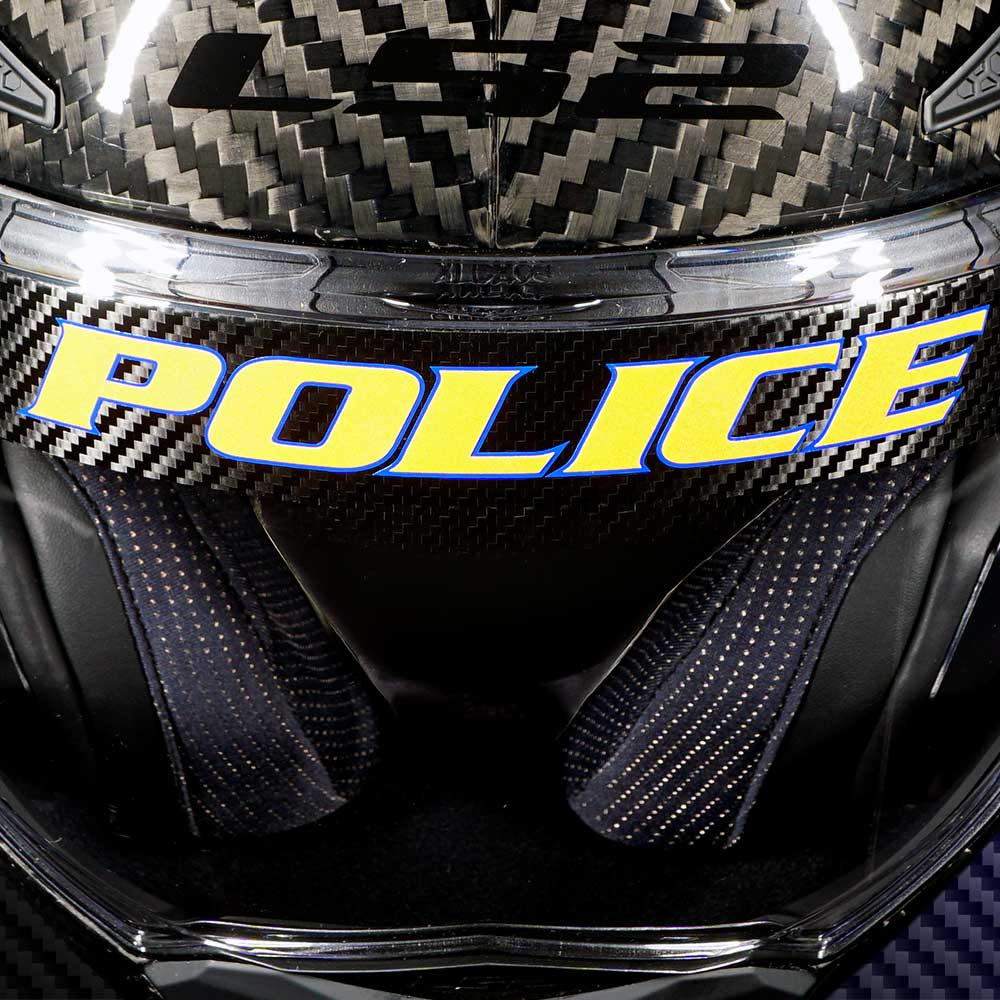 Clear from the front. The visor strip carries a broad POLICE identifier without overwhelming the carbon construction.
Front
A broad visor-strip identifier gives approaching motorists an immediate visual reference.
Side
The lettering follows the longest uninterrupted carbon panel without interfering with the hinge mechanism.
Rear
The treatment stays restrained so the certification area and carbon construction remain visible.
Across the front, the visor strip carries a broad POLICE identifier. Its position creates a clear visual reference for an approaching motorist while remaining integrated with the shield and upper eye-port area.
The yellow lettering has strong contrast against the black carbon. A blue outline ties the word back to the upper shell and prevents it from looking like a separate decal placed over an otherwise complete helmet.
The side POLICE lettering follows the rearward sweep of the lower shell. It uses the longest uninterrupted carbon panel without interfering with the hinge assembly or other operating components.
The rear is intentionally quieter. The yellow line continues around the shell, and portions of the side lettering remain visible from rear-quarter angles, but the design does not force an oversized graphic into the center of the helmet.
A professional police helmet does not need a graphic on every surface. It needs the right identification in the right places.
03 — Platform Function
The Modular Platform Behind the Paint.
Under the custom finish is the LS2 Advant X Carbon , a convertible modular helmet built with a carbon-fiber shell and a carbon-fiber chin bar that rotates 180 degrees toward the rear of the helmet.
The platform includes an anti-scratch outer visor prepared for a Pinlock Max Vision antifog insert, an internal drop-down sun visor, chin and top ventilation, a channeled EPS system, a removable and washable liner, multi-density EPS, a reinforced chin strap, a micrometric metal buckle, and an emergency-release system.
- Carbon-fiber shell and rotating carbon chin bar
- 180-degree convertible modular operation
- Outer shield with Pinlock-ready configuration
- Integrated drop-down sun visor
- Adjustable chin and upper ventilation
- Removable, washable comfort interior
For motor duty, the 180-degree chin-bar movement is one of the platform’s most useful characteristics.
In the closed riding position, the chin bar and outer shield provide the enclosed configuration many officers prefer for highway riding, adverse weather, and extended time on the motorcycle.
When the officer transitions to a roadside conversation or stationary assignment, the chin bar rotates fully toward the rear. It does not remain parked above the forehead as it would on a conventional flip-up modular helmet.
That gives the officer an open configuration for face-to-face communication without requiring the helmet to be removed. It also preserves a cleaner profile than a chin bar left standing above the shell.
For a motor officer whose shift regularly moves between roadway travel and direct public contact, that transition is not a novelty. It is part of how the helmet is used.
04 — Visual Conditions
Built for Changing Light.
Motor duty rarely provides consistent lighting.
An officer can move from direct sunlight to tree cover, an underpass, reflected vehicle glare, or a shaded intersection within seconds. Sunrise and sunset create a different problem: intense light concentrated near the horizon.
The Advant X Carbon’s drop-down internal sun visor gives the officer a way to respond to changing brightness without replacing the clear outer shield. The outer visor is also prepared for a Pinlock antifog insert.
The pictured visor treatment adds a strong front-facing POLICE identifier while maintaining the visual relationship between the blue, black, and yellow elements.
SeerSHADE for LS2
For departments seeking targeted glare control, SeerSHADE is precision-cut for the LS2 Advant X and Advant X Carbon outer lenses. It is designed to reduce low-angle glare at the upper portion of the shield rather than darkening the entire field of view. Carbon-fiber, POLICE, SHERIFF, reflective, and custom-lettering configurations are available.
That allows the front visor area to serve two practical purposes: glare management and clear agency identification.
05 — Duty Configuration
Communications Should Be Part of the Original Build.
A police motor helmet is not fully configured until the officer’s communication requirements have been addressed.
Treating the headset as an afterthought can lead to poor speaker alignment, awkward microphone placement, exposed wiring, or components that interfere with the liner, fit, or chin-bar movement.
The Advant X Carbon includes speaker pockets and internal routing for professional communication-system installation. Super Seer can configure compatible police, wired, wireless, and Bluetooth systems, with deliberate attention to speaker position, microphone placement, wire management, and strain relief.
For an agency order, the communication system should be identified before the helmets enter production.
- The department’s radio or motorcycle communication platform
- The required headset and speaker configuration
- The microphone style and preferred placement
- Whether the agency is supplying existing equipment
- Any officer-specific fit or hearing considerations
Addressing those details at the beginning allows the paint, graphics, interior components, and communication system to arrive as one completed duty configuration.
06 — Unit Identity
Custom Paint as a Department Standard.
Custom paint is sometimes dismissed as appearance alone. For a motor unit, that is an incomplete way to evaluate it.
The helmet is one of the most visible pieces of equipment worn by the officer. It appears during traffic enforcement, escorts, funeral details, parades, training, community events, and nearly every public-facing motor assignment.
Its colors and markings should look connected to the motorcycle, the uniform, and the department.
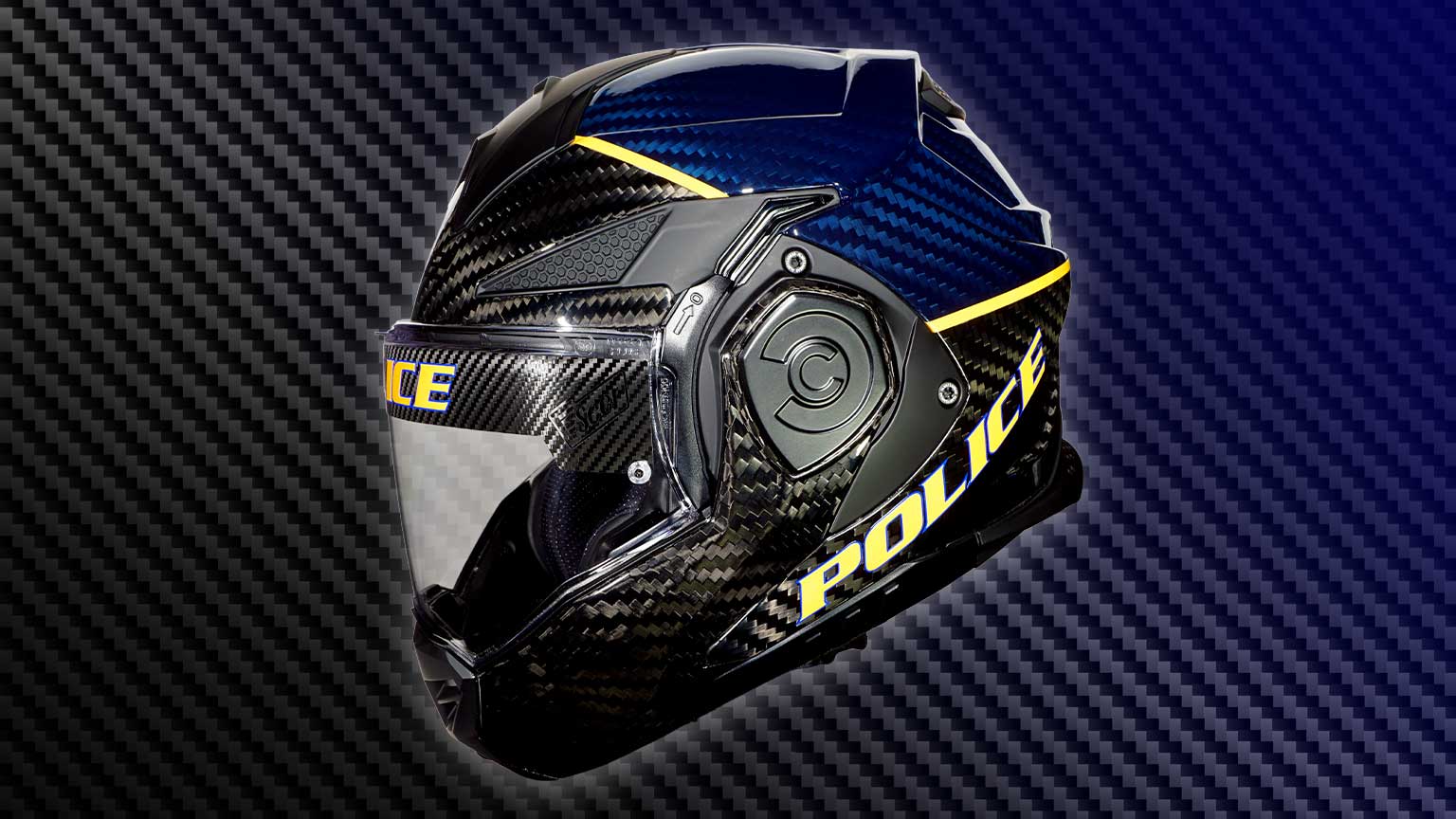 Blue carbon. Black carbon. Unmistakably POLICE. The exposed weave, crisp color break, and integrated POLICE identification define the helmet from every angle.
The objective is not simply to create an individually customized helmet. The stronger objective is to create a repeatable department standard.
A well-developed master configuration gives a unit consistency across different officers, helmet sizes, and future replacement orders. The motorcycles, helmets, uniforms, and identification then appear to be parts of one organized equipment program rather than unrelated purchases made at different times.
Super Seer can configure the LS2 Advant X Carbon with two-color paint, exposed carbon sections, department colors, reflective graphics, emblems, badges, officer names, ranks, call signs, unit numbers, and other agency identification.
The blue-and-black carbon scheme shown here is one application of that process. The same design architecture can be adapted to sheriff green, blue, silver, white, grey, traditional black-and-white, or a department-specific motorcycle color.
BUILT AROUND THE HELMET. DESIGNED AROUND THE DEPARTMENT.
The strongest motor-unit helmet designs work with the shape of the helmet—not against it. Department color defines the upper shell, exposed carbon anchors the lower structure, and a restrained accent connects the two. Police identification is placed where motorists can read it, while vents, hardware, modular components, and certification markings remain unobstructed.
That approach gives the department a recognizable helmet without hiding the material or overwhelming the shell.
07 — Certification-Conscious Finishing
The Rear View Shows the Standard of the Work.
The blue carbon continues cleanly across the crown. The yellow dividing line remains level as it crosses the rear shell. The exposed black carbon stays visually connected to the lower structure.
Most importantly, the exterior DOT certification label remains visible and legible.
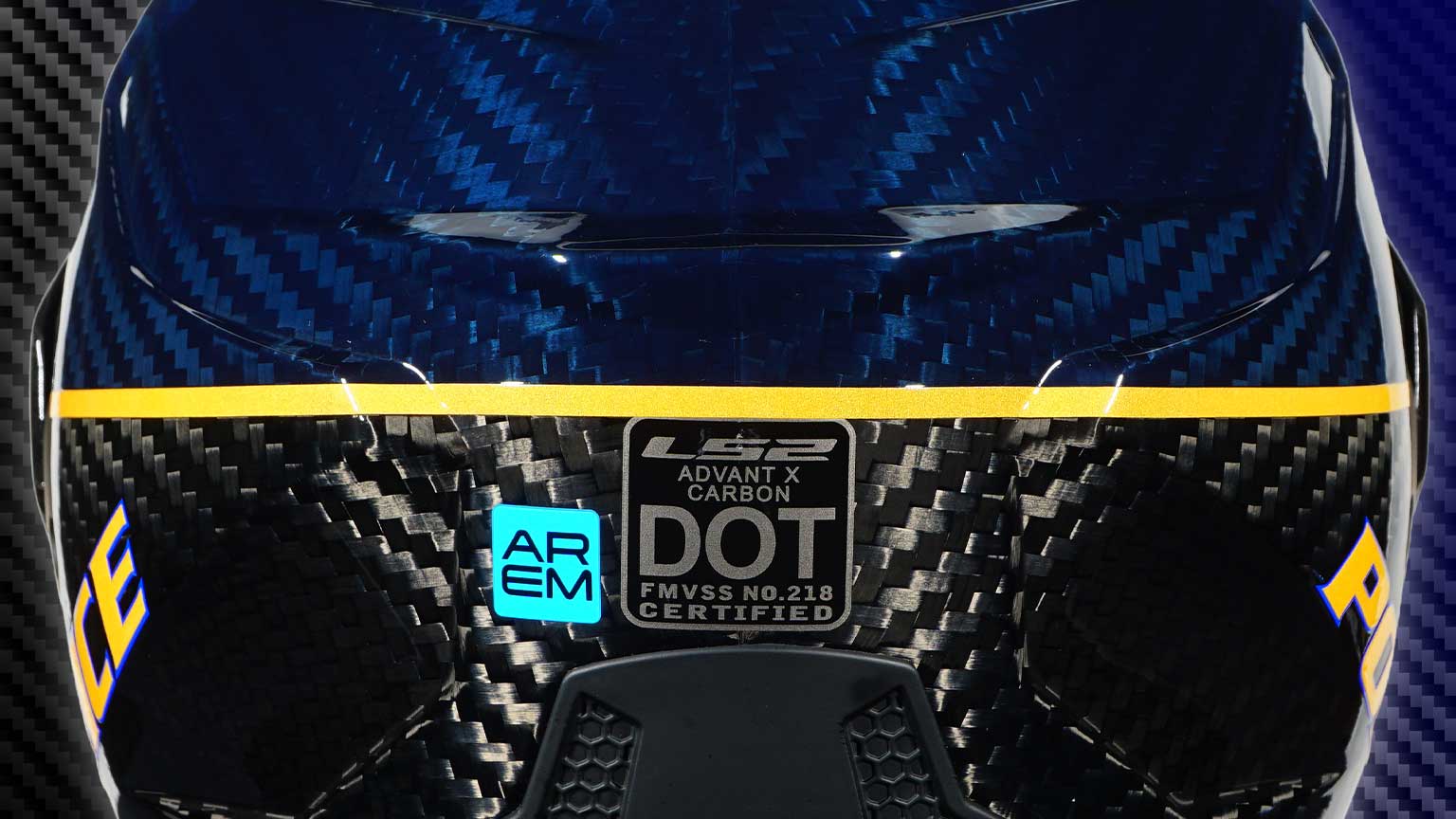 Complete 360-degree treatment. The paint scheme continues around the rear without forcing graphics into the certification area.
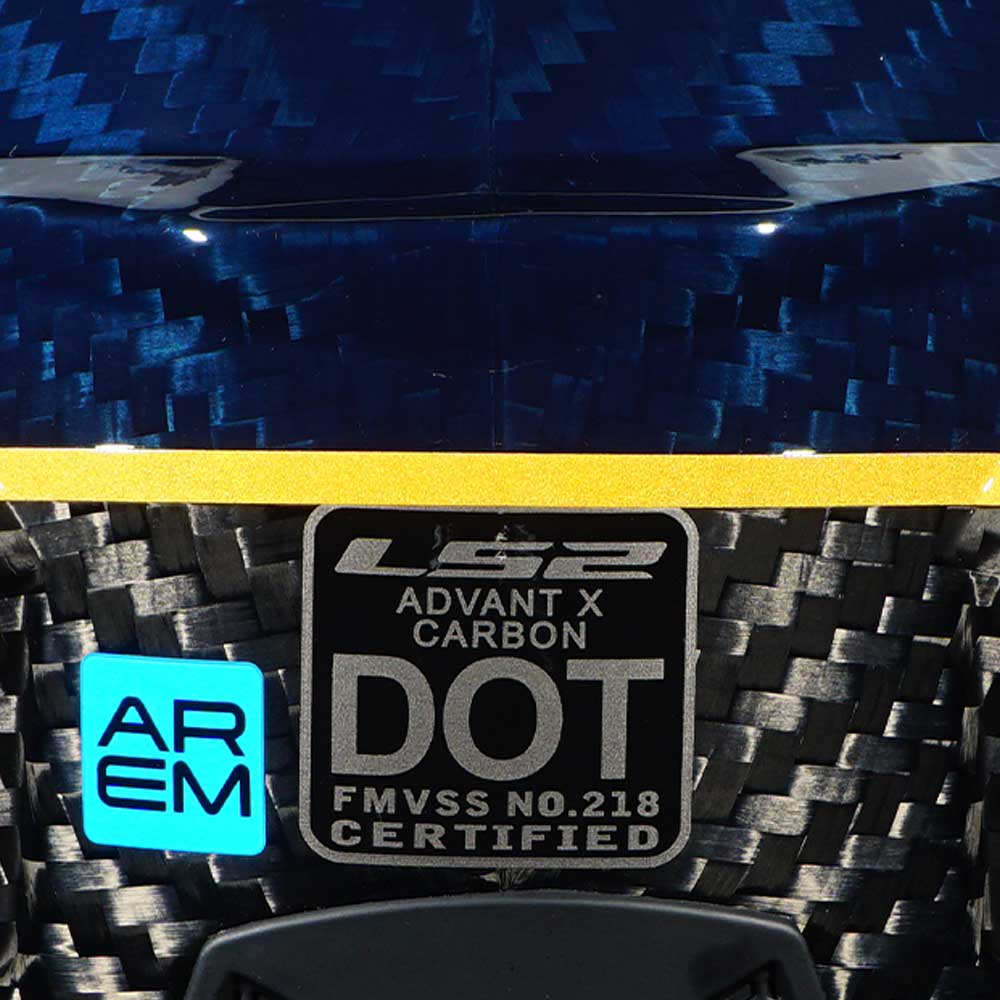 Label visibility. The neutral view makes the certification markings easy to inspect.
NHTSA explains that DOT-compliant motorcycle helmets sold in the United States carry required labeling on the outside rear, including the manufacturer or brand, model designation, DOT mark, FMVSS No. 218 reference, and certification wording. NHTSA also clarifies that the DOT mark represents the helmet manufacturer’s self-certification of compliance; it is not an advance approval issued by the agency.
That area should not be treated as unused space for paint or graphics.
On this helmet, the rear design works around the certification label rather than covering it. The helmet still receives a complete 360-degree finish, but the required information remains clear.
That is one of the differences between professional helmet customization and generic custom paint. The design has to respect the product as equipment.
08 — The Complete Police Configuration
Where an LS2 Becomes a Super Seer Police Helmet.
LS2 builds the modular carbon-fiber platform. Our job begins where the standard helmet ends.
We configure the paint around the shell rather than over it. We position identification according to how the helmet will be seen on the road. We incorporate department colors and artwork. We plan for the communication system. We preserve the certification markings. We finish the helmet so that it looks connected to the motorcycle and uniform.
The blue carbon and black carbon configuration demonstrates what that process can produce.
The blue upper shell establishes the department color. The black lower shell organizes the helmet’s mechanical structure. The yellow accent connects the finishes to the POLICE graphics. The modular platform remains fully recognizable and functional beneath the customization.
This is not a color scheme every department needs to duplicate. It is an example of how a motor-unit helmet should be approached: begin with the officer’s assignment, work with the helmet’s architecture, and use customization to support the department rather than decoration for its own sake.
A standard helmet can be purchased from any number of retailers. A department-ready helmet requires the paint, graphics, communications, fit, and procurement details to be resolved together.
Off the shelf, it is an LS2 Advant X Carbon. Configured by Super Seer, it becomes part of the motor unit.