For a police motorcycle officer, helmet color is not simply a showroom decision. The helmet is worn beside the same motorcycle, uniform, radio system, badge, and agency markings throughout the shift. Its finish becomes part of the motor unit’s visual identity.
Two of the strongest configurations available for the LS2 Advant X Carbon Police Helmet are high-gloss white with exposed carbon and high-gloss white with a matte-black lower finish.
At first glance, the difference seems straightforward. One displays the carbon weave; the other presents the lower structure as solid black. In practice, each configuration creates a distinctly different police motorcycle helmet.
The White/Carbon version feels technical, dimensional, and material-forward. The White/Black version feels restrained, uniform, and traditionally law enforcement. Neither finish changes the core modular platform. The decision is about what the department wants the helmet to communicate.
Option One
White and Carbon: Let the Material Become Part of the Design.
The White/Carbon configuration makes the helmet’s construction visible. High-gloss white establishes the upper shell, while exposed carbon continues across the brow, lower side panels, chin bar, and rearward structure.
The woven pattern follows the helmet’s curves and changes as light moves across the surface. From several feet away, the helmet reads as a clean white-and-black police design. At closer range, the lower section reveals that the dark finish is visible carbon fiber rather than a flat black color.
That gives the helmet a more technical and performance-oriented character without requiring a complicated painted graphic.
Keeps the carbon weave visible across the lower structure
Adds visual depth as light moves across the shell
Works well with restrained, high-contrast police graphics
Creates a more distinctive motor-unit appearance
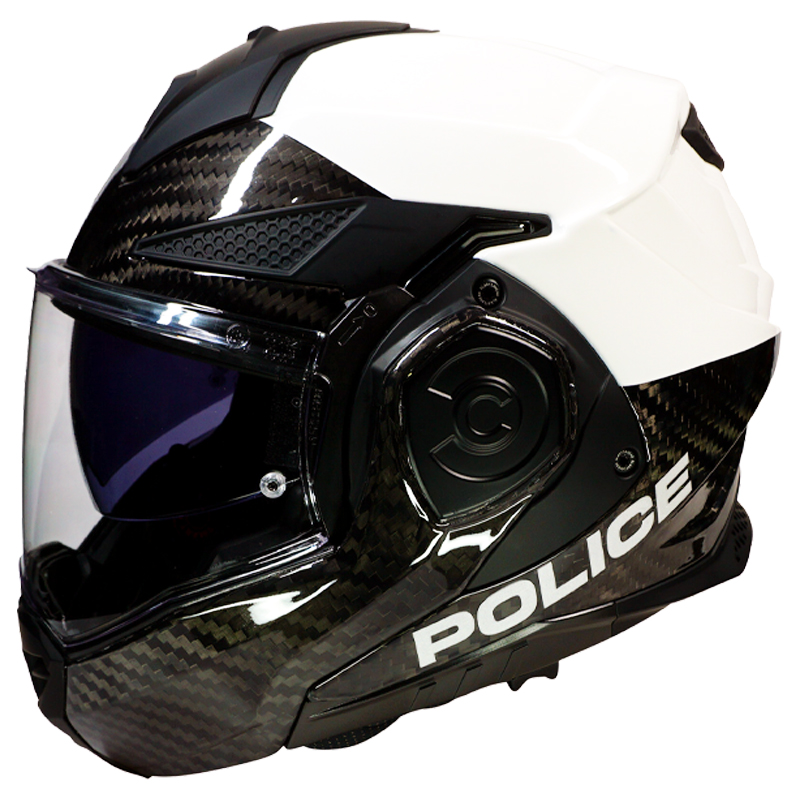 White and Carbon: the exposed weave adds depth across the brow, lower shell, side panels, and modular chin bar.
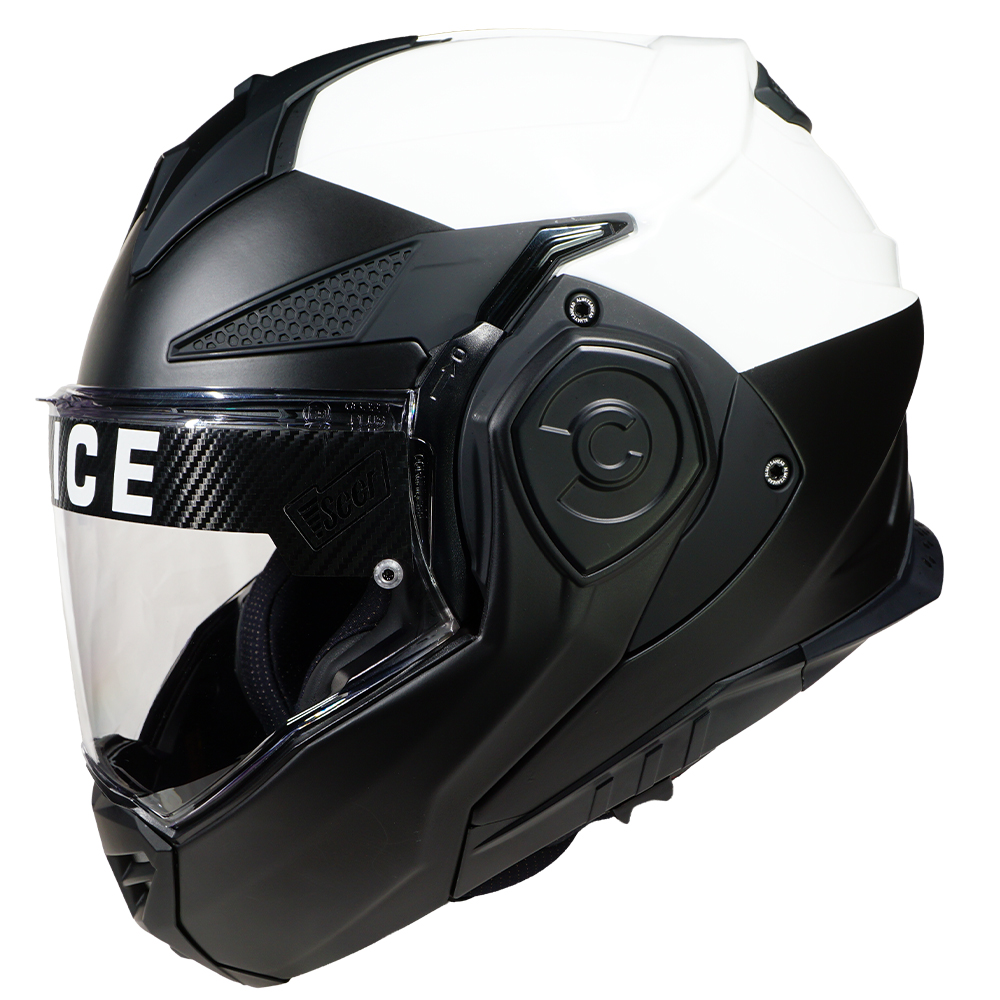 White and Black: high-gloss white over a matte-black lower structure creates a clean, controlled law-enforcement appearance.
Option Two
White and Black: A Cleaner, More Traditional Police Presentation.
The White/Black configuration takes a more restrained approach. High-gloss white defines the upper shell, while matte black controls the lower shell, chin bar, side structure, vents, and visible mechanical components.
Instead of emphasizing the carbon weave, the matte-black finish visually quiets the lower half of the helmet. The hardware does not disappear, but it becomes less dominant. The white crown, POLICE identification, badge, and department graphics can then carry more of the design.
This creates a crisp profile that integrates naturally with black-and-white motorcycles, dark uniforms, and departments that want a highly repeatable fleet appearance.
Creates a classic black-and-white law-enforcement relationship
Visually unifies the vents, hinge, shield hardware, and chin bar
Provides a predictable background for badges and lettering
Supports a consistent appearance across a full motor unit
LS2 Police Helmet Finish Comparison
White / Carbon vs. White / Black.
The table below isolates the finish decision from the graphics, visor treatment, communication system, and other optional components that may appear in individual product photographs.
Consideration
White / Carbon
White / Black
Overall Character
Technical, dimensional, and material-forward
Clean, restrained, and traditionally law enforcement
Lower-Shell Appearance
Visible carbon weave
Solid matte-black finish
Behavior in Light
Weave and depth change with reflections and viewing angle
More consistent and visually quiet across changing light
Graphic Strategy
Strongest with controlled, high-contrast identification
Supports simple or detailed department graphics
Hardware Integration
Hardware blends into the visible carbon structure
Hardware merges into the solid matte-black lower field
Fleet Appearance
Distinctive and equipment-driven
Uniform, conservative, and highly repeatable
Helmet Platform
LS2 Advant X Carbon
LS2 Advant X Carbon
Modular Function and Comms
Same platform capabilities and installation options
Same platform capabilities and installation options
Daily Motor Duty
What Police Motorcycle Officers Will Notice.
The finish affects identity and visual presentation. The daily-duty function comes from the LS2 platform and the way Super Seer completes the police configuration.
01
Same Modular Operation
Both finishes retain the Advant X Carbon’s 180-degree rotating chin bar for transitions between roadway travel and face-to-face contact.
02
Identification Matters More
Letter size, contrast, reflectivity, and placement have a greater effect on police recognition than the base finish alone.
03
Graphics Are Separate Options
POLICE lettering, badges, shield strips, reflective accents, names, ranks, and call signs can be configured independently of the finish.
04
Communications Come First
Speaker position, microphone placement, routing, connectors, and strain relief should be confirmed before graphics are finalized.
05
Review Real Lighting
Exposed carbon changes more noticeably with daylight and reflections. Matte black maintains a more consistent silhouette.
06
Think Beyond One Officer
A department standard should remain consistent across sizes, current personnel, spare helmets, and future replacement orders.
Compare the Finish, Not the Accessories
The Photographs Show More Than a Paint Difference.
The two examples are not configured identically. The White/Carbon helmet displays large side POLICE lettering and a lowered internal sun visor. The White/Black helmet uses a carbon-pattern visor strip with front identification while the side appears comparatively restrained.
Those are graphic and accessory decisions—not automatic features of either finish. When reviewing the two helmets, isolate the shell treatment from visor tint, SeerSHADE or visor lettering, side graphics, badges, reflective material, and communication equipment.
This example emphasizes the exposed carbon, side POLICE lettering, and internal sun visor.
This example emphasizes the solid lower finish and front visor identification.
Important Ordering Detail
POLICE lettering shown in product photography may be optional and should be listed explicitly on the final quote. The same applies to badges, reflective graphics, shield treatments, communication systems, and officer-specific identification.
Department Selection Guide
Which Finish Fits Your Motor Unit?
The right answer should come from the motorcycle, uniform, agency graphics, and the appearance the department wants to repeat—not from the helmet viewed in isolation.
Choose White / Carbon When…
- The unit wants the carbon construction to remain visibly part of the design.
- A more technical or performance-oriented appearance supports the agency’s identity.
- Graphics will remain controlled enough to let the weave stay visible.
- The motorcycles or unit graphics already use carbon, metallic, or premium visual details.
Choose White / Black When…
- The department wants a traditional black-and-white law-enforcement presentation.
- The lower shell and hardware should read as one subdued structure.
- The helmet will carry a detailed badge, multiple identifiers, or stronger graphics.
- Maximum visual consistency across the fleet and future replacement orders is the priority.
Choose Either When Function Is Driving the Decision.
Fit, modular operation, communications, shield requirements, and professional police customization come from the LS2 Advant X Carbon platform and the completed Super Seer configuration—not from whether the lower shell displays exposed carbon or matte black.
Evaluate the Complete System
The Best Finish Is the One That Looks Intentional Across the Entire Unit.
Before approving White/Carbon or White/Black, place the proposed helmet beside the department motorcycle, motor jacket, badge, shoulder patch, windshield, fairing, microphone, and existing reflective striping. Then review the helmet from the front, sides, rear-quarter angles, and the officer’s normal seated position.
White/Carbon is strongest when the department wants visible material, technical depth, and a more distinctive helmet. White/Black is strongest when the department wants controlled contrast, a traditional police profile, and a highly uniform fleet identity.
Both can look professional. Both can be configured for daily motor duty. The difference is what the department wants the helmet to say before the officer speaks.
Frequently Asked Questions
White / Carbon and White / Black LS2 Police Helmet Questions.
Is the White/Black version still an LS2 Advant X Carbon helmet?
Yes. The White/Black configuration is still based on the LS2 Advant X Carbon platform. The solid matte-black visible finish should not be confused with LS2’s separate non-carbon Advant X model.
Does the color scheme change the modular operation?
No. Both configurations use the same underlying 180-degree rotating chin-bar platform. The paint and visible finish change the appearance, not the fundamental modular operation.
Can both finishes receive POLICE lettering and reflective graphics?
Yes. Super Seer can configure either finish with reflective identification, department graphics, emblems, badges, names, ranks, call signs, and other police-specific details.
Can communications be installed in either version?
Yes. Communication compatibility is tied to the helmet platform and selected equipment, not the color scheme. Confirm the headset, speaker, microphone, routing, and motorcycle or radio interface before production.
Which finish is more visible?
Both examples use a white upper shell. Real-world recognition depends on more than the base finish, including lettering size, contrast, reflective material, viewing angle, road conditions, and lighting.
Is POLICE lettering included automatically?
Not necessarily. The final quote should identify every graphic, badge, visor treatment, reflective component, and communication accessory required for the department order.